Mum, want to keep showing up for your family? Emotional boundaries are non-negotiable

Mothers are used to giving everything. Maybe you pride yourself on being present for your family? On being their rock, their safe space, their emotional haven… For many mums, that’s the role we aim to fulfill for our children. But it might also extend to your partner, and to other family members… your parents, your in-laws, and even to your friends. You want to be there for everyone!
And that’s admirable! But do you lose yourself in the process? What happens when you give so much that your emotions start to blend with those of others? That’s when you can no longer distinguish what is yours: your feelings, your needs, your wants.
That’s why emotional boundaries are essential: so you remain grounded in who you are and can keep showing up for the ones you love.
Overall, maintaining emotional boundaries means taking responsibility for your own emotions while not feeling responsible for others’. Let’s explore what these two sides of the boundary really mean.
Taking responsibility for your own emotions
You know the phrase we shout when we’re angry: “You make me feel… [fill in the blank]” ? Well, the truth is that, while people can trigger emotions, the way you experience those triggers is ultimately yours. YOU feel the emotion.

The same situation can trigger very different responses in two different people, depending on their past experiences and beliefs. It can even trigger different responses in the same person, depending on the context.
If your partner reminds you to take a cardigan because it might get cold, do you feel loved and cared for? Or do you feel annoyed that they assumed you wouldn’t think about it? I’ve definitely had both reactions on different days (which makes it very difficult for my husband to know what to do).
Healthy emotional boundaries mean no longer blaming someone else for your uncomfortable feelings.
Let’s imagine that your partner is working late and you’re once again left on your own for the kids’ bedtime routine. You might feel abandoned, overwhelmed, unsupported, exhausted, or a billion other things. But none of these feelings are your partner’s fault. They are simply signals pointing to unmet needs.
If you feel abandoned, you might need some loving words from your partner reminding you that they appreciate you taking care of the home. If you feel overwhelmed, maybe you need to lower the bar for the evening (for example, if bath time is a battle, do the children really need to be bathed every night, or can you skip it tonight since you’re on your own?).
You are the one responsible for identifying those needs and getting them met. And note that you don’t have to do this alone, asking for help is also part of taking ownership!
Another example: at work, your boss ignores your suggestion and, a few weeks later, presents the exact same idea without acknowledging your contribution. You might feel angry, unrecognised, or unfairly treated. All these emotions are perfectly understandable.
But let’s be clear, these emotional reactions are yours, and they’re telling you something. Maybe you need to be more assertive if you want to be recognised. Or maybe this workplace simply isn’t the right environment for you. (There could be many other interpretations too.) Either way, your boss didn’t make you feel this way. You simply felt this way.
Once you take ownership of your emotions, you regain your power because your wellbeing is no longer dependent on other people changing their behaviour. You recognise that no one can dictate how you feel.

Of course, this approach isn’t meant to trigger any shame if you tend to feel things deeply. I experience “disproportionate” emotions quite often too. And I know that the thought “I shouldn’t be feeling that way” is not helpful at all. The goal is to stop blaming someone else for what you feel. It’s not about starting to blame yourself instead!
Every emotion carries a message. Allow yourself to feel it, then ask: “What unmet need is this emotion pointing to?” And once you see it, take a step toward meeting that need.
No longer feeling responsible for others’ emotions
In the same way that people are not responsible for your emotions, you are not responsible for theirs either.
You cannot control someone else’s emotional experience. You only have control over yourself, your response, your actions, and the thoughts you choose to entertain.
Maintaining emotional boundaries with the people we love can be difficult because emotions are contagious. When someone close to us is stressed, upset, or overwhelmed, we naturally pick up on it; and before we realise it, we’re feeling stressed too.
That’s why emotional boundaries require the awareness to recognise “this feeling is not mine.” If your partner is in a bad mood, that doesn’t mean you have to be in a bad mood too. As Mel Robbins beautifully says, “Let them.” Just let them be grumpy, you are allowed to be joyful!
These boundaries can be especially tricky when it comes to our kiddos, because it’s really hard for a mum to witness her child suffer (even if the “suffering” is simply caused by a “no” to an ice cream and nothing existential). For some mums, there may also be the (irrational and sometimes unconscious) belief that if our child looks unhappy, we are a bad mum. Of course, that’s not true. Children cannot be happy all the time, and they need to experience uncomfortable emotions. Otherwise, how would they learn to handle life?
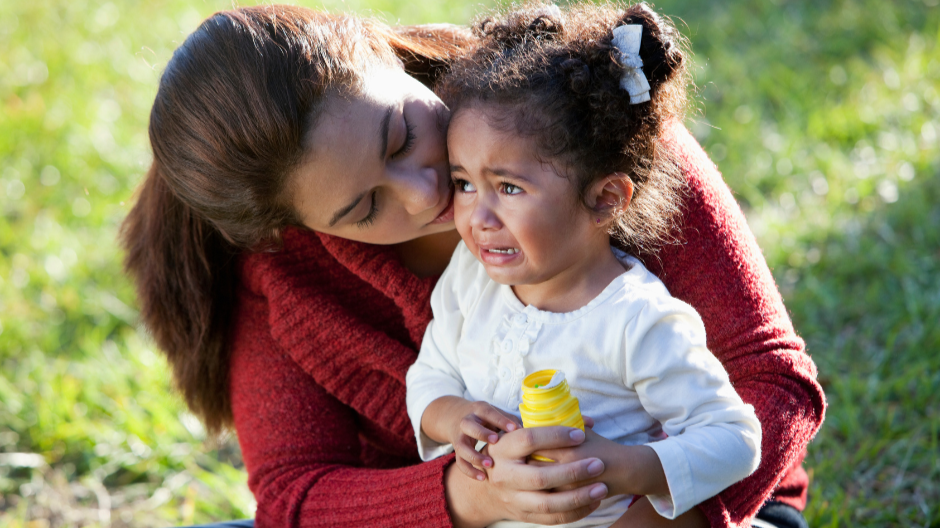
So remember: it’s not your job to make everyone happy. In fact, you might go above and beyond to please someone, and they may still be unhappy. You might organise the perfect family day out, and your child will complain the whole time. And that’s okay, it shouldn’t prevent you from enjoying your day.
In your day-to-day life, when you notice yourself absorbing someone else’s mood, try pausing and asking: “Is this mine, or am I picking this up?” That simple question can help you become more aware of your own emotional experience, so you can own what belongs to you and respond appropriately to what’s coming up for others.
Maintaining emotional boundaries with empathy

Now comes the important question: how do you maintain healthy emotional boundaries and still care for others?
Because of course, you don’t want to become insensitive or self-centred. You want to be a loving and caring mother, a supportive partner, a good friend… You want to be there for the people you love.
And the beauty of emotional boundaries is that they actually allow you to better support the people around you. Because you no longer let their emotional experience drain you, you have more energy to show up for them.
Let’s say your child comes home from school crying because others were making fun of him. Yes, it feels heartbreaking. And you can hold space for your child’s sadness, anger, shame (or any other feeling) while recognising that these feelings are not yours.
You will also have your own feelings in response to the situation (anxiety or powerlessness, just to name a few possibilities). And you can acknowledge both emotional realities as separate.
So you hold space for your child’s feelings, but you let them be. You don’t try to fix them.
Interestingly, when we try to fix someone else’s feelings, it’s often because their emotional experience is making us uncomfortable. In those moments, we’re mixing our emotions with theirs (i.e. porous emotional boundaries).
These same principles apply to adults too. But with adults, there’s an extra layer of choice on how to apply your boundaries. Sometimes we don’t have the emotional capacity to hold space for someone else’s worries, and that’s okay.
You don’t have to pick up every call from your friend who always goes on and on about everything that’s going wrong in their life. You can assess if you have the mental space and emotional energy to show up. If you’re exhausted and need time for yourself, you can send a message saying you’ll call them the next day (or check if it’s urgent if you’re concerned). You get to decide when to be present, and when you need to step back.

In conclusion, healthy emotional boundaries mean owning what is yours, and only what is yours. It’s about recognising and accepting that each individual’s emotional experience is unique and belongs to them. It’s also about developing awareness of your own limits and how much of your energy you can dedicate to holding space for others. Ironically, when you keep your emotional boundaries, you become even more compassionate and empathetic toward others.