How to Manage Mum Stress Through Daily Mindfulness Habits

Mum life is full of love and wonder, but it can also be deeply stressful. Sometimes, it can be hard to seize the little joys we once imagined would come so naturally, especially when we’re buried under dirty laundry, kids’ dentist appointments, and three missed calls from our manager about the report that was due yesterday…
Mindfulness might be just what you need to release a little of the tension you’ve been carrying. Don’t worry, I’m not going to tell you to sit in silence and meditate for one hour a day, I know your schedule doesn’t allow that!
In a previous blog, I explained how you can bring mindful moments into your daily life (read here). In this blog, I’d like to discuss more specifically how you can use mindfulness to reconnect with yourself, reduce anxiety, and better enjoy your life as it is.
When mum life feels overwhelming, come back to your breath
Mums often have to juggle a million things at once, and it can feel like your mind never gets a break. Some days, you are simply rushing from one emergency to another, while your to-do list keeps getting longer and longer.

That’s when your breath can become your anchor: it gives you something steady to come back to, even in the chaos of mum life. Focusing on your breathing helps you return to your physical sensations instead of staying up in your mind, ruminating. You might be short on time, but you can always find 10 seconds for a deep breath. And yes, one deep breath will not instantly make the stress melt away. It might not even have a noticeable effect at first. But these breaths will add up, and getting into the habit of regularly taking them can make a difference.
You can sprinkle those deep breaths throughout your day. My suggestion is to squeeze them into transitions: when you’ve just sat down in the car and you’re waiting for the kids to put their seatbelts on, before switching on your laptop in the morning, or when you’re about to open Zoom for a meeting. Just take a few seconds to inhale and exhale slowly. Easy peasy!

Now, you can always add a bit more. If you have 30 seconds instead of 10, you can choose to take three deep breaths instead of just one. You can place one hand on your belly and one hand on your heart to feel more present in your body. You can also focus on your physical sensations, scan your body, relax your jaw, relax your shoulders… There are many variations of this exercise.
The point is, when you gently come back to your body, again and again, over time you feel more grounded and connected with yourself.
When your mum mind won’t switch off, simply observe
It’s not uncommon for mums to worry a lot: Will your child be okay at their first art class? Have you forgotten to pack the safety blanket? What are your in-laws gonna say about the mess in your house? These thoughts can be exhausting.
A key principle of mindfulness is the non-judgemental observation of what is. In other words, when an anxious thought pops up, just let it be. You can visualise your thoughts as clouds in the sky: they come and go. Nothing is fixed, even the darkest cloud will eventually pass…
This approach is very different from fighting the thought. Usually, when you try not to think about something, it’s really difficult to keep it out of your mind. With mindfulness, we simply welcome the thought. However, we don’t identify with it: you can have an anxious thought, but you are not your anxiety.
It can help to create some distance by telling yourself, “I’m having the thought that…” For instance, “I’m having the thought that all the other mums will judge me for arriving late.” This helps remind you that thoughts are not facts. You can’t know for sure that the other mums will judge you (and hopefully, they’ll actually show compassion).

Another little trick is to label the thoughts and give them nicknames: the “I’m a bad mum” thought becomes Guilt-Trip Gloria, and the “Something bad is going to happen to my child” thought becomes Worst-Case Wendy. This trick is not about laughing at yourself or pretending your worries do not matter, but a bit of humour helps create a tiny bit of space between you and the thought.
Whatever you choose, the idea is to let the thought be without attaching too much weight to it (because it’s only a thought).
Come back to the present and notice the beauty of motherhood
Motherhood is full of tiny wonders: a small hand squeezing yours, silly games after dinner, walking side by side on the way home… but if your mind is elsewhere, you might miss these moments.
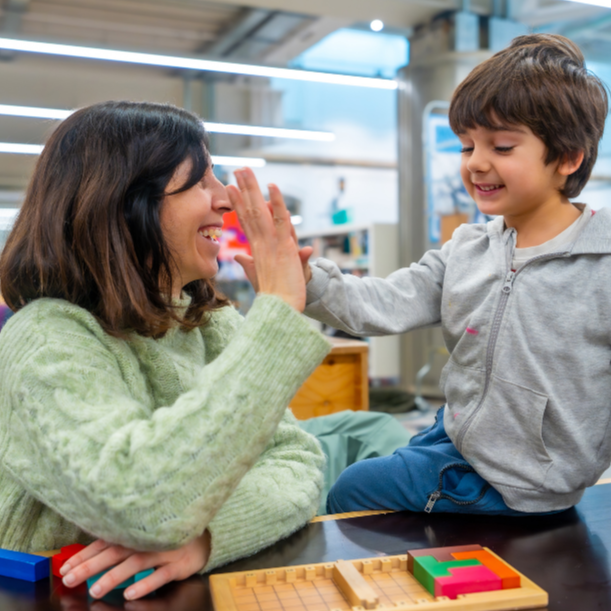
Mindfulness is about being in the here and now. Or, more precisely, it’s about coming back to the here and now. Because your mind will wander; that’s what human minds do… So if you’ve been thinking about work while your child was telling you about their day, don’t judge yourself (remember, mindfulness means no judgement). As soon as you notice your mind was elsewhere, gently bring it back and refocus your attention on your child.
A good way to come back to the present is to reconnect with your senses. Do you feel your child’s hand in yours? Can you see the sunbeams dancing between the leaves? Do you smell the scent of freshly cut grass? You can connect with any of your five senses to return to the present: what do you see, hear, touch, smell, or taste?
You might notice that you struggle to be present, especially if you’re going through a stressful period. And that’s okay. Mindfulness is about noticing. You notice your mind was running through your to-do list, then you bring it back to the puzzle you’re putting together with your child.
The more you practise, the sooner you’ll notice when your mind has drifted, and the easier it becomes to come back to the small, beautiful moments happening right in front of you.
Final thoughts
Mindfulness can be applied to any part of your day, and it doesn’t require any extra time. It’s about developing small habits of reconnecting with the present and observing without judgement. And it’s about imperfect practice, because no mum can be fully present all the time. The aim is not to become a calm guru. We simply want to bring mindfulness into ordinary moments, creating small pockets of peace within a busy day.